
TECHNICAL REFERENCE
A Process-Technology Fit Matrix and Decision Guide for Low-Carbon Heating in Textile Wet Processing and Finishing
A reference guide for textile engineers, facility managers, brands, and decarbonization teams
Author: Ali Hasanbeigi, PhD
The textile and apparel industry currently accounts for roughly 2% of global anthropogenic greenhouse gas (GHG) emissions. A key challenge for the industry in lowering its carbon footprint is its heavy reliance on thermal energy, particularly process steam for production processes. Heat is closely linked to more than half of the total energy demand in the textile industry.
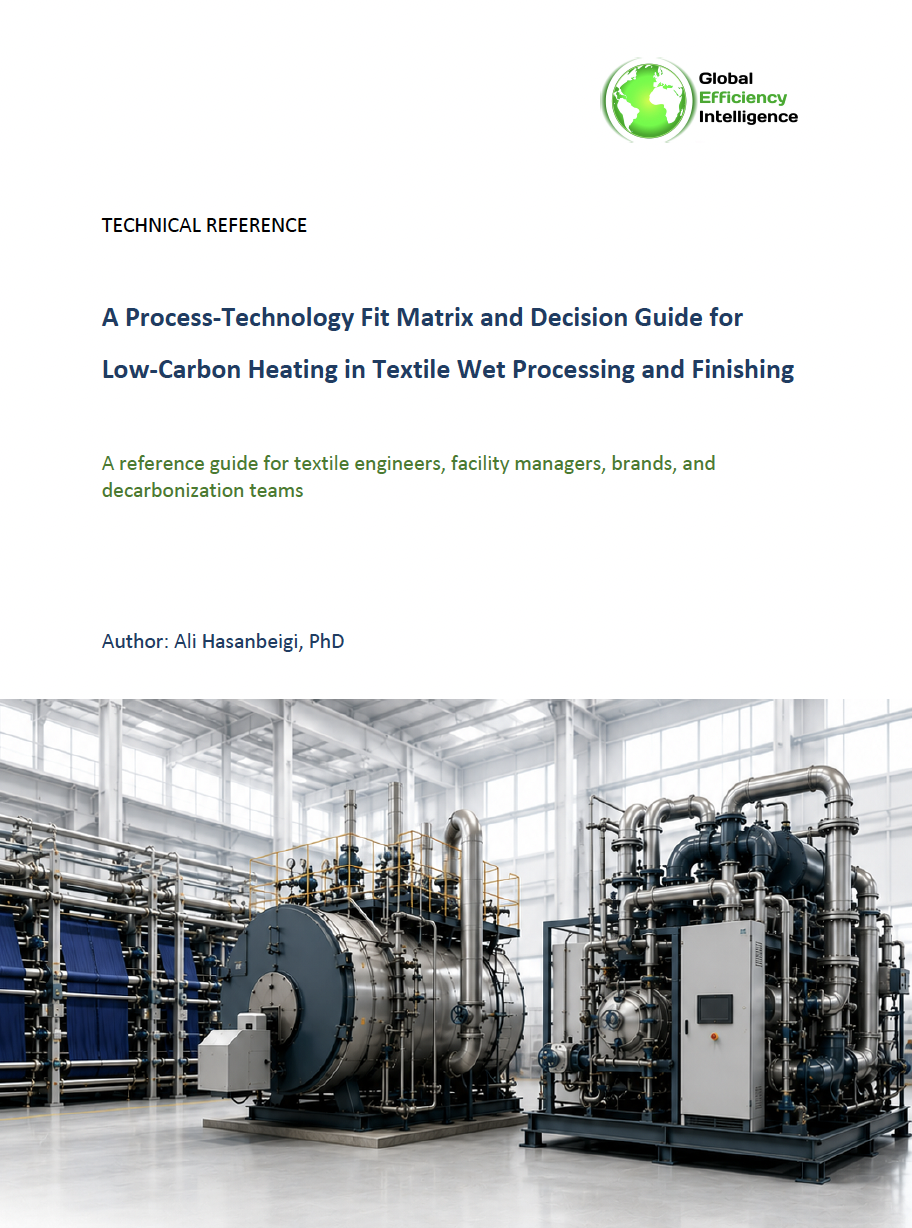
In textile plants, process heat is primarily generated by combustion boilers that use fossil fuels. Thermal oil boilers are also used in some textile plants with wet processing and finishing operations, and can account for a significant share of fuel use, sometimes 30–40%. In most countries, boilers in the textile industry use fossil fuels such as coal, natural gas, or fuel oil as an energy input, which results in substantial carbon dioxide (CO₂) emissions.
Replacing these boilers with low-carbon heating technologies is technically feasible today for many textile wet processing and finishing applications. But textile mill managers, brands, and decarbonization teams face a practical question: which technology fits which process, and which option makes sense at the plant level?
The answer depends on more than temperature. It also depends on the heat carrier required by the process, such as hot water, saturated steam, thermal oil, hot air, or direct electric heating. A process operating at 90°C may still require steam if the equipment needs steam injection, latent heat, or isothermal temperature control. A process operating at 180°C is usually not a steam load at all, but a high-temperature dry-heat load served by thermal oil, hot air, or direct electric heating.
This technical reference guide helps users make that distinction. The Process-Technology Fit Matrix: Low-Carbon Heating Technologies for Textile Wet Processing and Finishing in Chapter 3 maps major textile wet processing and finishing operations to suitable low-carbon heating technologies. It helps users identify which technologies fit each process based on temperature, heat carrier, and process condition.
Chapter 4 then provides Decision Tree 2.0 for textile facilities seeking to adopt low-carbon thermal energy technologies. It is an enhanced plant-level decision guide that screens loads by heat carrier first, then temperature, and helps facilities choose between steam heat pumps, hot-water heat pumps, electric boilers, electric thermal oil boilers, direct process electrification, and sustainable biomass transition options. Chapter 5 discusses the economics of electrification in textile facilities.
How to use this technical reference guide
Start with Chapter 2 to become familiar with the main low-carbon heating technologies for textile wet processing and finishing. Then read Chapter 3 to identify which technologies fit each process and heat load. After that, use Chapter 4 to walk through the plant-level decision tree and determine the most appropriate pathway for your facility. Chapter 5 explains the economics behind these choices, including lifetime cost, payback, and risk.
For project-specific techno-economic calculations, use GEI’s free Textile Heating Electrification Tool.
Key Takeaways
▸ Steam heat pumps, generally up to about 150°C in commercial applications today, can cover much of the saturated-steam demand in textile wet processing and finishing and beat coal and natural gas boilers on lifetime cost in most countries we have analyzed.
▸ Hot-water heat pumps are best used for boiler feedwater preheating, process-water preheating, condensate and makeup-water heating, and some low-temperature washing and rinsing loads. In most existing wet processing and finishing plants, they are a support or hybrid technology rather than a full replacement for steam.
▸ Electric steam boilers and electric thermal oil boilers can replace conventional steam or thermal oil systems, but their emissions and cost performance depend strongly on access to cleaner and lower-cost electricity.
▸ Direct process electrification, such as resistance, IR, and RF technologies, is promising for drying, curing, and finishing. Some options are already commercial, while others remain at pilot or early-market stage for textile applications.
▸ Sustainable biomass remains a short-term transition option where electrification is not yet feasible, but only when there is verifiable sustainable biomass supply and proper pollutant controls.
▸ Process fit and plant-level economics must be assessed together. Use the matrix in Chapter 3 first to identify technically suitable options, then use Decision Tree 2.0 in Chapter 4 to select the most appropriate plant-level pathway.
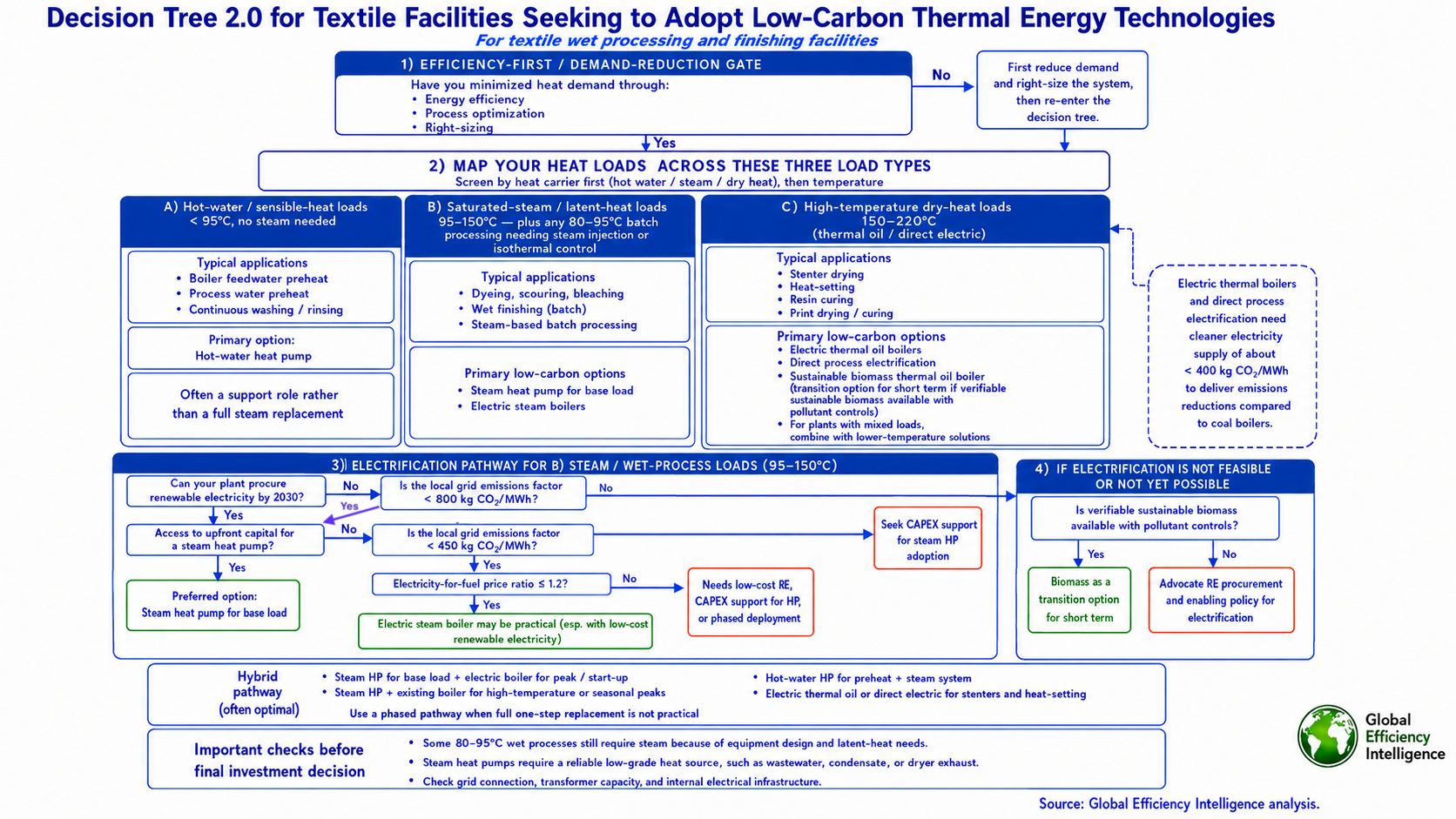
Figure 1. Decision Tree 2.0 for textile facilities seeking to adopt low-carbon thermal energy technologies.
(Source: Author’s analysis)
Read the full report for detailed explanation of the decision tree.
To read the full report and see complete results and analyses, download the full report from the link above.
Interested in information and decarbonization studies on the global textile and apparel industry? Check out our list of textile industry publications and tools on the Textile Sustainability Hub.
Don't forget to follow us on LinkedIn and X to get the latest about our new blog posts, projects, and publications.
Work with GEI on your heat electrification strategy
Need help developing an electrification strategy for your company or supply chain? Global Efficiency Intelligence (GEI) works with apparel brands, retailers, and textile manufacturers to develop practical heat electrification and thermal decarbonization strategies.
Using the methodologies, decision framework, screening approaches, and techno-economic tools that we have developed over the years, GEI can help organizations develop customized decarbonization roadmaps tailored to their supplier base, facilities, regions, and climate goals.
Our support can include supplier screening and prioritization, portfolio-level opportunity assessment, technology pathway analysis, regional readiness assessment, pre-feasibility studies, scenario analysis, supplier engagement planning, and phased implementation roadmaps. GEI has previously supported global apparel brands and their supplier networks in identifying suitable facilities, technologies, and pathways for reducing thermal energy emissions while managing cost, operational risk, and implementation challenges.
To learn how GEI can support your company or supply chain, contact us at info@globalefficiencyintel.com.